- March 6, 1809, 217 years ago — Death of Thomas Heyward Jr..
- March 6, 1724, 302 years ago — Birth of Henry Laurens, President of the Continental Congress.
- March 7, 1707, 319 years ago — Birth of Stephen Hopkins, signer of the Declaration of Independence.
- March 7, 1699, 327 years ago — Birth of Susanna Boylston Adams, mother of John Adams.

Commonly Flown: October 1774 – 1776
Flag Description
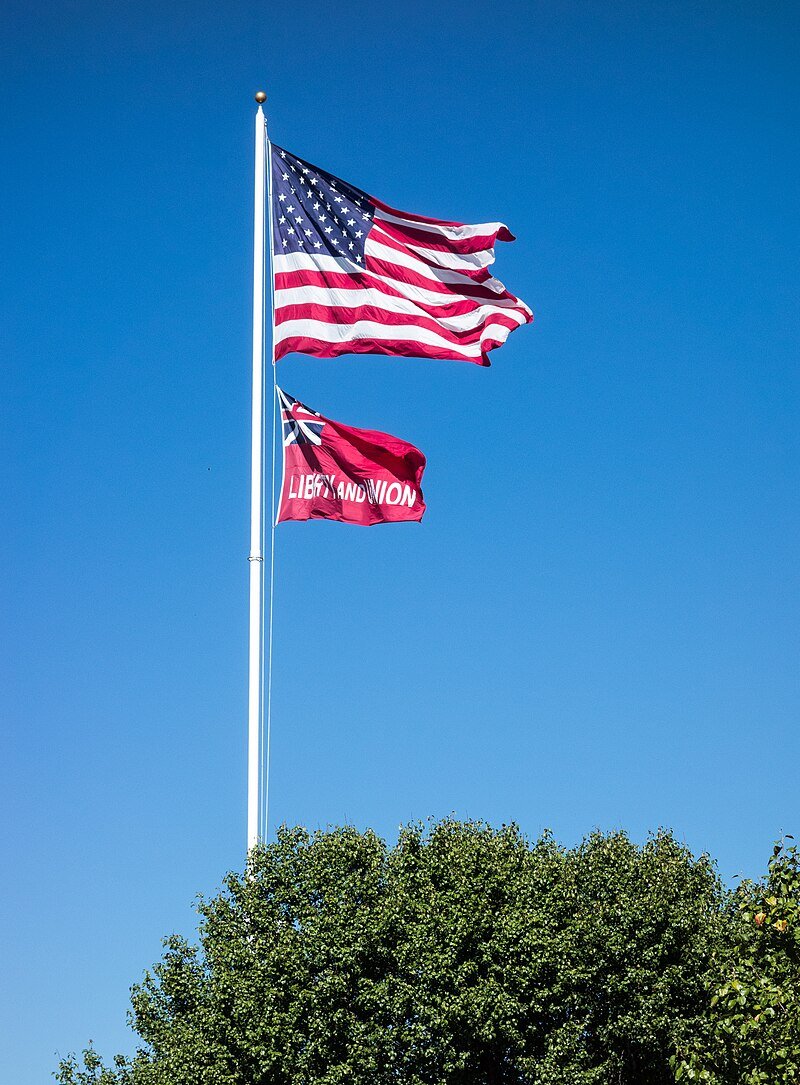
The Taunton Liberty and Union Flag combined the British Red Ensign with bold white lettering that read “Liberty and Union.” First raised on October 21, 1774, in Taunton, Massachusetts, it was one of the earliest flags to publicly challenge British authority while still expressing a desire for unity. Its hybrid design reflected the tension between loyalty to the Crown and the growing demand for colonial rights.
Editorial Commentary
The Taunton Liberty and Union Flag is a visual paradox—part protest, part plea. By retaining the British Red Ensign and overlaying it with the words “Liberty and Union,” the flag captured the conflicted spirit of late 1774. Colonists were not yet calling for independence, but they were unmistakably demanding change. This flag flew not in battle, but above a Liberty Pole in the town square—a civic declaration rather than a military one.
Its message was layered. “Liberty” spoke to the colonists’ grievances: taxation without representation, arbitrary governance, and the erosion of self-rule. “Union” suggested a hope that reform could preserve ties with Britain. But as events unfolded, the flag’s symbolism evolved. What began as a call for reconciliation became a stepping stone toward revolution.
In the context of Patriot Echoes, the Taunton Flag stands as a transitional emblem. It reminds us that revolutions rarely begin with clarity—they begin with contradiction. This banner marked the moment when colonial loyalty began to fracture, and civic identity began to take shape. It is a flag of hesitation, conviction, and the first public stirrings of American defiance.