- March 6, 1809, 217 years ago — Death of Thomas Heyward Jr..
- March 6, 1724, 302 years ago — Birth of Henry Laurens, President of the Continental Congress.
- March 7, 1707, 319 years ago — Birth of Stephen Hopkins, signer of the Declaration of Independence.
- March 7, 1699, 327 years ago — Birth of Susanna Boylston Adams, mother of John Adams.
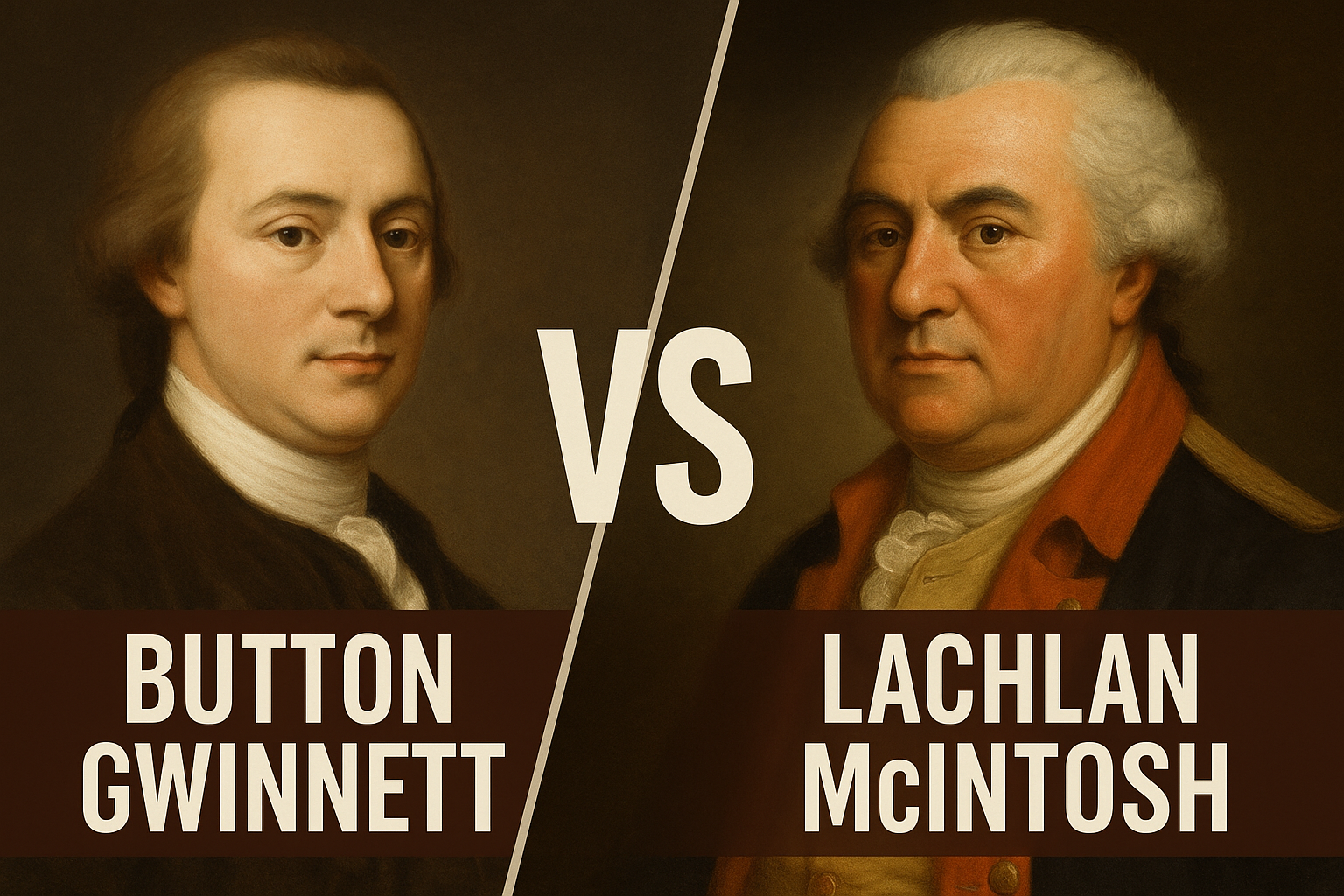
Duel: Button Gwinnett vs. Lachlan McIntosh
Date: May 16, 1777
Location: Near Savannah, Georgia
Weapons: Pistols, 12 paces
Cause of the Duel
The conflict grew out of a long-standing political and military rivalry:
- Button Gwinnett, a signer of the Declaration of Independence and then acting governor of Georgia, had political ambitions and wanted command of Georgia’s Continental forces.
- Lachlan McIntosh, a respected Continental Army officer, opposed Gwinnett’s leadership and publicly criticized his conduct during a failed expedition against British-held East Florida.
When McIntosh openly accused Gwinnett of actions “dishonorable to the State,” Gwinnett considered it a direct attack on his honor and demanded satisfaction.
Quotes from the Combatants
No verbatim duel ground dialogue survives, but two important documented statements do:
Gwinnett’s Challenge (paraphrased from records)
He declared McIntosh’s remarks “a lie, pronounced in the presence of the legislature” and demanded he recant or meet him in a duel.
McIntosh’s Response
McIntosh refused to withdraw his words, saying he would “give no satisfaction but what a gentleman ought to give.” This effectively accepted the challenge.
Outcome of the Duel
- Both men fired almost simultaneously.
- Both were hit:
- Gwinnett: Wounded in the thigh, with the ball shattering the bone.
- McIntosh: Slightly wounded in the leg.
- Gwinnett’s wound became infected, and he died three days later, on May 19, 1777.
- McIntosh survived and continued his military career — but public backlash forced him to leave Georgia for a period.
Witnesses / Seconds
Each man selected a second, consistent with dueling custom:
Gwinnett’s Second:
- Major Samuel Elbert
McIntosh’s Second:
- Colonel John Marbury
Both stood as official witnesses, measured the distance, oversaw the rules, and testified afterward.
In the Press
The Gloucester Journal Mon, Aug 11, 1777 ·Page 3
Two ships are arrived at Nantz from South-Carolina with rice and indigo: they bring letters of the 5th of June, which mention a duel being fought in Georgia between Button Gwinnett, Esq; the Governor, and Col. M'Intosh; they both were very much wounded, and the former died the next day. The above Mr. Gwinnett was the son of the late Rev. Mr. Gwinnett, Rector of Hatherly, in Glocestershire.
The North-Carolina Weekly Gazette Fri, Aug 15, 1777 ·Page 2
We hear from Georgia, that Col. Elbert made a descent upon East Florida with the brigade under his command, and after some successful skirmishing with the enemy, in which he took some prisoners, and retook a number of Negroes, returned with the brigade safe into Georgia. That General Mackintosh was entirely recovered from the wounds he some time ago received in an engagement with the enemy, and lately in a duel with Governor Gwinnett. That a privateer from that state had tatel.
Disclaimer:
The articles on this site include original commentary as well as transcriptions and excerpts from historical newspapers, books, and other public domain sources. Every effort has been made to preserve the accuracy and context of these materials; however, their inclusion does not imply authorship, agreement, or endorsement by Patriot Echoes unless explicitly stated. Sources are cited where available. All materials are presented for educational, archival, and civic purposes. If you believe any item has been misattributed or requires correction, please contact the editorial team.