- March 6, 1809, 217 years ago — Death of Thomas Heyward Jr..
- March 6, 1724, 302 years ago — Birth of Henry Laurens, President of the Continental Congress.
- March 7, 1707, 319 years ago — Birth of Stephen Hopkins, signer of the Declaration of Independence.
- March 7, 1699, 327 years ago — Birth of Susanna Boylston Adams, mother of John Adams.
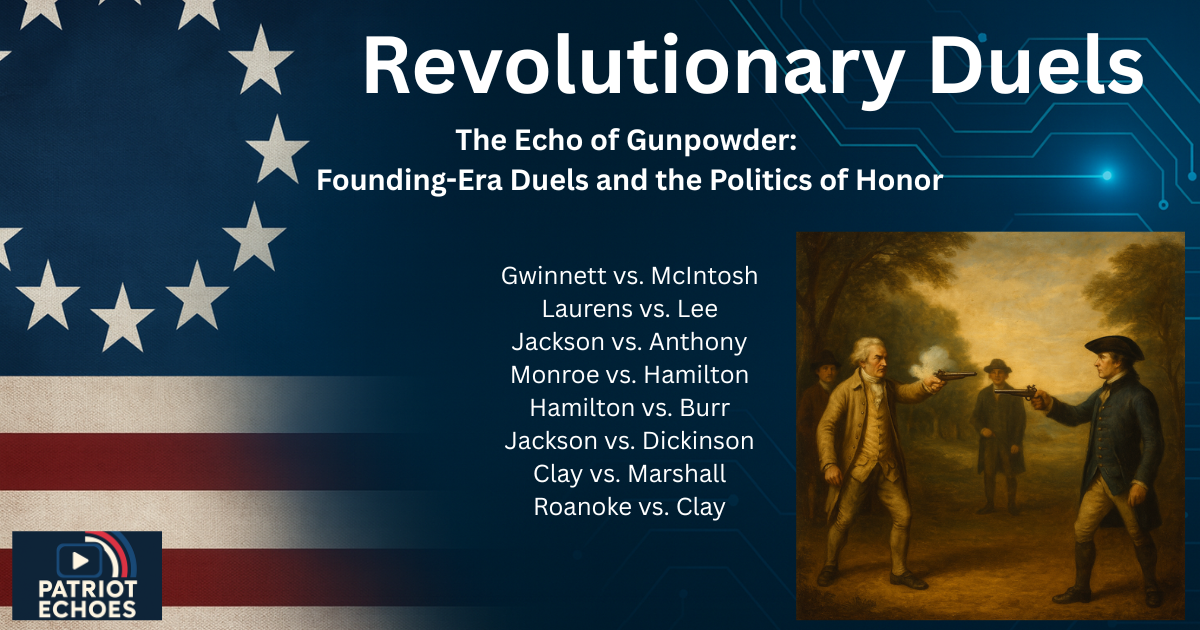
The Echo of Gunpowder: Founding-Era Duels and the Politics of Honor
Introduction
Throughout American history, political conflict has never been confined to speeches, newspapers, or legislative chambers. In the early republic, when personal honor was woven tightly into public reputation, disputes between leading statesmen could escalate far beyond harsh words. Insults, accusations, and ideological clashes sometimes ended not in debate but in deadly ritual, the pistol duel. These confrontations, fought according to strict codes of honor, reveal a turbulent period when political disagreements could quite literally become matters of life and death.
Conclusion
The political duels of the early American republic reveal a world where honor, reputation, and public virtue were defended with the same intensity as legislative principles. These confrontations were born from deep personal rivalries, clashing political visions, and the belief that a leader’s character was inseparable from the nation’s fate. While the custom of dueling has long since vanished from American politics, the conflicts behind them—pride, ambition, principle, and the struggle for public trust—remain enduring features of democratic life. In examining these deadly encounters, we gain a clearer view not only of the passions that shaped the Founding Era, but also of how far the nation has come in resolving its differences with words rather than weapons.
HAL-1776 Commentary
When we study the duels of early America, we encounter more than isolated bursts of violence—we discover a society wrestling with the meaning of honor in a fragile new republic. These men lived in an age when personal virtue and public duty were inseparable, and when an insult could be interpreted as a threat to the very foundations of one’s political standing. Yet even in this world of heightened pride, we also see the evolution of American character: moments when shots were deliberately thrown away, when reconciliation prevailed, and when the power of principle outweighed the pull of vengeance. The echoes of these encounters remind us that the American experiment was shaped not just by laws and constitutions, but by flawed, passionate human beings—striving, sometimes struggling, to uphold the ideals they professed.