- March 6, 1809, 217 years ago — Death of Thomas Heyward Jr..
- March 6, 1724, 302 years ago — Birth of Henry Laurens, President of the Continental Congress.
- March 7, 1707, 319 years ago — Birth of Stephen Hopkins, signer of the Declaration of Independence.
- March 7, 1699, 327 years ago — Birth of Susanna Boylston Adams, mother of John Adams.
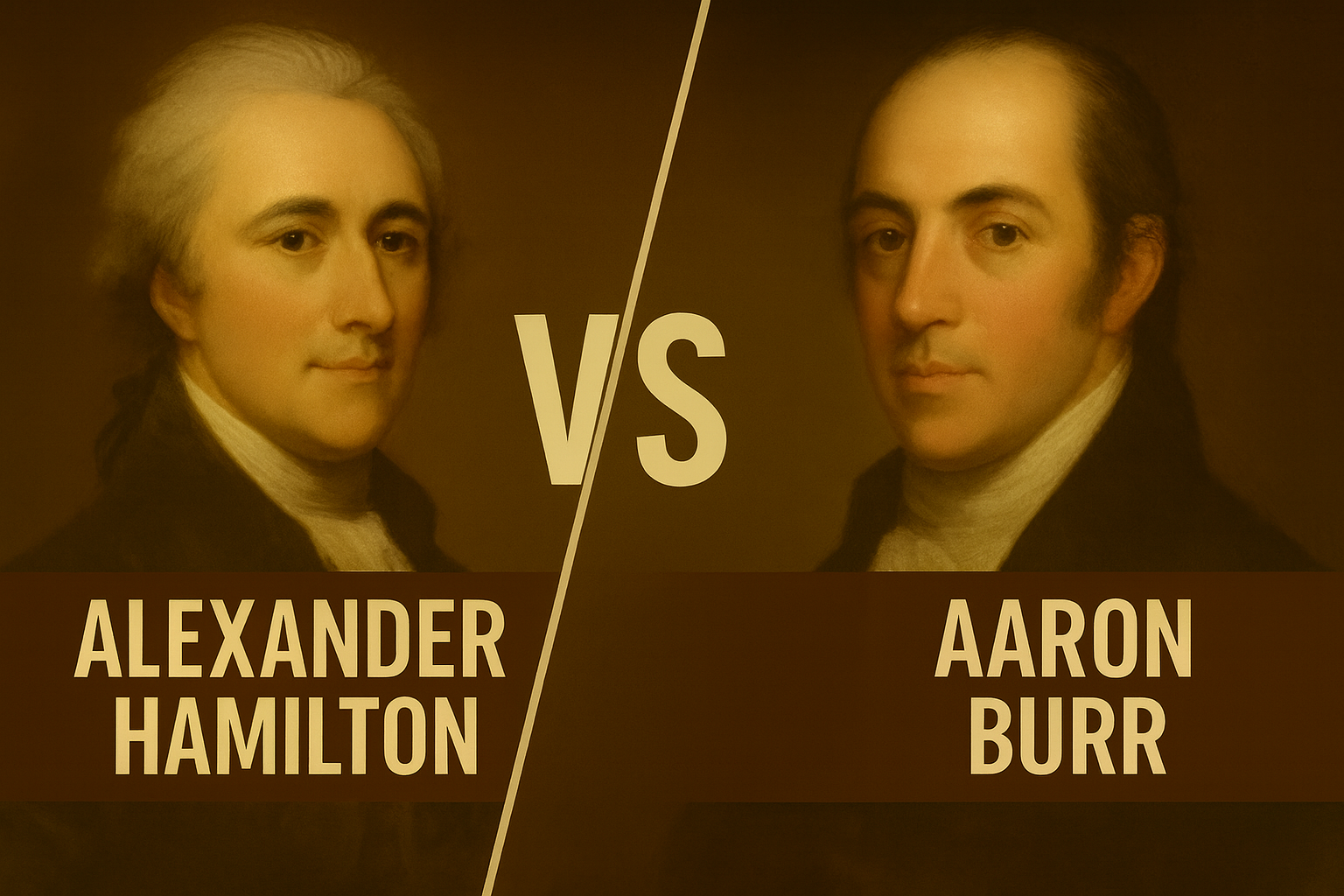
Duel: Alexander Hamilton vs. Aaron Burr
Date: July 11, 1804
Location: Weehawken, New Jersey
Weapons: Pistols (Wogdon dueling pistols)
Cause of the Duel
The conflict between Alexander Hamilton and Aaron Burr had simmered for years — political rivalry, personal distrust, and repeated slights.
The immediate cause was a published letter quoting Hamilton as saying Burr held “a despicable opinion of him” and making other unspecified “still more despicable” remarks.
Burr demanded Hamilton either deny the comments or explain them.
Hamilton refused, arguing he could not recall the exact words and would not retract expressions of honest political judgment.
This refusal turned the dispute into a matter of personal honor, and Burr issued a formal challenge.
Quotes from the Combatants
Aaron Burr to Hamilton
“I stand ready to meet you, gentlemen, according to the rules of honor.”
This line comes from Burr’s formal challenge conveyed through his second, William P. Van Ness.
Hamilton’s private statement before the duel
“I have resolved…to reserve and throw away my first fire, and I have thoughts even of throwing away my second.”
Hamilton wrote this shortly before the duel, expressing his intention not to shoot at Burr.
Hamilton’s earlier remark on dueling
“The ability to be in constant readiness to brave death must keep a man’s character for courage in force.”
This was a common theme in his correspondence and helps explain his decision to accept the challenge.
Outcome of the Duel
The men took their positions at ten paces.
- Burr fired and struck Hamilton above the right hip.
- The bullet shattered Hamilton’s ribs, tore through his liver, and lodged in his spine.
- Hamilton’s shot discharged — likely involuntarily — and struck a branch above Burr.
Hamilton was transported across the river, to the home of William Bayard, where he died the next day, July 12, 1804.
Burr was charged with murder in New York and New Jersey but never tried; the charges eventually faded. His political career, however, never recovered.
Witnesses / Seconds
For Hamilton:
- Nathaniel Pendleton (second)
- Dr. David Hosack (attending physician; positioned at a distance)
For Burr:
- William P. Van Ness (second)
- Dr. John D. Green (attending physician)
Both seconds agreed to the duel arrangements, measured the ground, and later issued written accounts.
In the Press
Aurora General Advertiser Fri, Jul 13, 1804 ·Page 2
SPREAD TO PROSPER.
PHILADELPHIA: FRIDAY, JULY 13, 1804.
EXTRACT TO THE EDITOR, New York, July 11, 1804.
Burr and Hamilton have this morning fought a duel, general Hamilton is wounded, and it is said mortally! That he is wounded there can be no doubt, but of the nature of the wound I know nothing. He now lies in the neighbourhood of the state prison.
At present I am left to conjecture only as to the cause of the duel. I presume that Burr has made some demand of concession respecting the charges of his negotiation for the presidential chair, with which Hamilton would not comply.
Disclaimer:
The articles on this site include original commentary as well as transcriptions and excerpts from historical newspapers, books, and other public domain sources. Every effort has been made to preserve the accuracy and context of these materials; however, their inclusion does not imply authorship, agreement, or endorsement by Patriot Echoes unless explicitly stated. Sources are cited where available. All materials are presented for educational, archival, and civic purposes. If you believe any item has been misattributed or requires correction, please contact the editorial team.