- March 6, 1809, 217 years ago — Death of Thomas Heyward Jr..
- March 6, 1724, 302 years ago — Birth of Henry Laurens, President of the Continental Congress.
- March 7, 1707, 319 years ago — Birth of Stephen Hopkins, signer of the Declaration of Independence.
- March 7, 1699, 327 years ago — Birth of Susanna Boylston Adams, mother of John Adams.
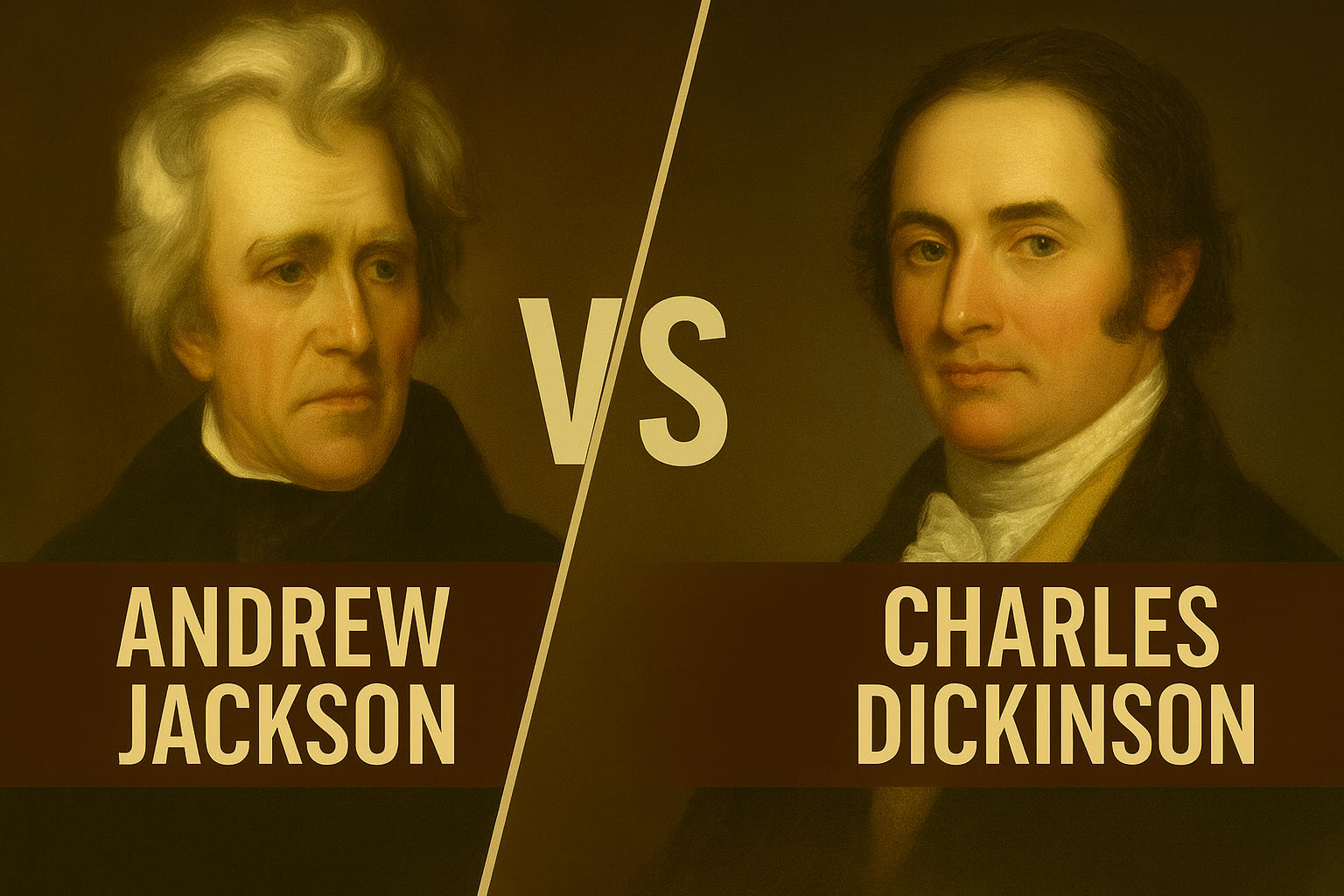
Duel: Andrew Jackson vs. Charles Dickinson
Date: May 30, 1806
Location: Harrison’s Mills, along the Red River, Kentucky
Weapons: Pistols
Cause of the Duel
The conflict began as a dispute over a horse race wager involving Andrew Jackson’s prized stallion.
Charles Dickinson — an accomplished duelist and known marksman — accused Jackson of cheating in the settlement of the bet.
The quarrel escalated rapidly when Dickinson published newspaper attacks calling Jackson:
- a “worthless scoundrel,”
- a “coward,” and
- a man of “base and contemptible character.”
In the honor culture of the early republic, these public insults were intolerable. Jackson demanded satisfaction. Dickinson, confident in his skills, eagerly accepted.
Quotes from the Combatants
Dickinson’s insult (printed in a local paper)
Jackson was described as a
“poltroon and a coward”
— language certain to provoke a duel.
Jackson to his second before the duel
“I should have shot him in the brain, had he shot me through the heart.”
Jackson said this to Thomas Overton, reflecting his resolve to fire second but fire to kill.
Jackson on Dickinson’s skill
“He shoots a pistol better than any man I ever saw.”
A remark showing Jackson knew he was facing superior accuracy.
Outcome of the Duel
The men faced off at 24 feet, unusually close.
- Dickinson fired first — his bullet struck Jackson in the chest, breaking ribs and lodging near his heart. Jackson remained standing.
- Jackson then took deliberate aim and fired. His pistol misfired at first (a technical “hair trigger” issue), but under the dueling code the shot was allowed. His second attempt hit Dickinson in the abdomen.
Dickinson died later that night from internal bleeding.
Jackson survived, but carried the bullet in his chest for the rest of his life.
The duel hardened Jackson’s reputation as fiercely courageous but also dangerously vengeful.
Witnesses / Seconds
For Andrew Jackson:
- Thomas Overton (second)
- Dr. John H. Shelby (attending)
For Charles Dickinson:
- Hanson Catlett (second)
- Dr. B. W. Claiborne (attending)
Overton and Catlett oversaw the arrangements and later wrote detailed accounts.
In the Press
The Post-Boy Tue, Jul 29, 1806 ·Page 2
NASHVILLE, (Ten.) June 10.
"CIVILIZATION"
We have already stated the death of Mr. Dickinson, in a duel with Gen. Andrew Jackson; the following are the preliminaries of the negociators in this affair:—
"On Friday, the 30th inst. we agree to meet at Harrison's Mills, on Red River, in Logan County, State of Kentucky, for the purpose of settling an affair of honor, between General Andrew Jackson, and Charles Dickinson, Esq. It is understood the meeting will be at the hour of 7 in the morning.
"It is agreed, that the distance shall be 24 feet; the parties to stand facing each other with their pistols drawn perpendicular—when they are ready, the single word fire to be given, at which they are to fire as soon as they please.
"Should either fire before the word given, we pledge ourselves to shoot him down instantly.
"The person to give the word to be determined by lot, as also the choice of position. We mutually agree that the above regulations shall be observed in the affair of honor depending between Gen. Andrew Jackson, and Charles Dickinson, Esq.
"THOMAS OVERTON, "HANSON CATLET.
"Nashville, May 24, 1806."
Disclaimer:
The articles on this site include original commentary as well as transcriptions and excerpts from historical newspapers, books, and other public domain sources. Every effort has been made to preserve the accuracy and context of these materials; however, their inclusion does not imply authorship, agreement, or endorsement by Patriot Echoes unless explicitly stated. Sources are cited where available. All materials are presented for educational, archival, and civic purposes. If you believe any item has been misattributed or requires correction, please contact the editorial team.